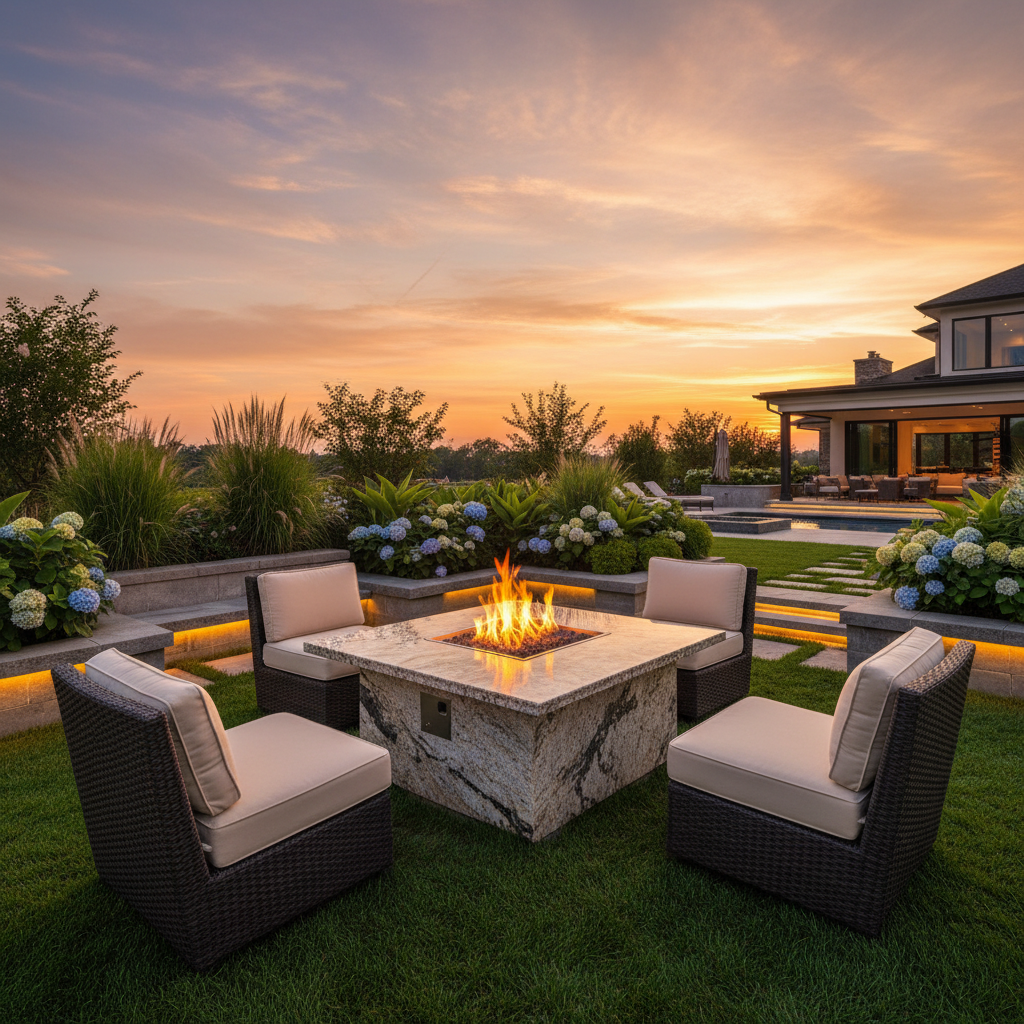


Best Fire Pit Tables for 2026: Complete Buyer's Guide
Disclosure: Inspired Fire & Water Features is a participant in the Amazon Services LLC Associates Program, an affiliate advertising program designed to provide a means for sites to earn advertising fees by advertising and linking to Amazon.
Some links on this page are affiliate links. If you buy through them we may earn a small commission at no cost to you.
By using our affiliate link, you are still supporting small businesses and we appreciate you for it.
A fire pit table is the rare patio purchase that gets more useful over time. The first month, it's a novelty — you light it up for guests, take photos, enjoy the moment. The first year, it's where you find yourself most evenings from April through October. By year three, it's become the gravitational center of your backyard, the thing your kids ask to turn on at dinner, the spot where you actually use the patio furniture you bought five years ago.
Industry data backs this up: fire pit tables are the fastest-growing segment in the outdoor fire features category, with Grand View Research projecting 9.3% annual growth through 2030 — faster than any other patio category, faster than outdoor kitchens, faster than even outdoor heaters. The reason is simple: a fire pit table does the job of a coffee table, a heater, and a focal point all at once.
But the category has also flooded with low-quality entries chasing the trend. A $250 table on Amazon and a $2,500 table from a specialty supplier look almost identical in photos. The differences show up in year two — when the powder coat starts rusting, the burner orifice clogs because it was never properly engineered, or the GFRC top develops hairline cracks because it was poured too thin.
This guide cuts through that noise. We've sorted through dozens of current models, focused on what actually matters in long-term ownership, and picked the seven we'd buy with our own money in 2026.

Quick Picks: Best Fire Pit Tables 2026
| Category | Pick | Size | Approx. Price |
|---|---|---|---|
| Best overall | Outland Living Series 403 | 44" Rectangle | $400–$550 |
| Best premium GFRC | Modeno Aurora Fire Table | 34" square | $700–$1,000 |
| Best budget under $500 | Bond Manufacturing Newcastle | 34" square | $250–$350 |
| Best linear design | The Outdoor GreatRoom Company Vintage | 52" linear | $1,800–$2,400 |
| Best for small patios | The Outdoor GreatRoom Company Cove Square | 29" square | $1,400–$1,700 |
| Best dining-height | Real Flame Riverside | 60" rectangular | $1,500–$1,900 |
| Best convertible to natural gas | The Outdoor GreatRoom Company Stonefire | 48" round | $1,900–$2,500 |
Short version: start with the Outland Series 401 if you're new to fire pit tables. It's the most-reviewed propane fire pit table on the market, it's well-engineered, and it works in almost any patio. If you have the budget and want something that looks intentional rather than utilitarian, step up to a Modeno or The Outdoor GreatRoom Company table.
What Is a Fire Pit Table?
A fire pit table is a propane- or natural-gas-fueled fire feature built into a table surface. At chat height (24–26 inches tall), the surrounding ledge functions as a coffee table — somewhere to set drinks, appetizers, and phones while the burner is on or off. At dining height (28–30 inches), the table works as a full dining surface when fitted with a burner cover.
The propane tank, when present, hides inside a sealed compartment in the base. A flexible line connects the tank to a regulator, then to a key valve, then to the burner. Most modern fire pit tables include push-button piezoelectric ignition, so lighting is one motion: turn the key valve, push the spark.
This is different from a traditional fire pit (lower, no ledge, often wood-burning) and from a DIY fire pit kit (where you build the enclosure yourself). A fire pit table is a complete, ready-to-use product — delivered assembled or mostly assembled, ready to light within an hour of unboxing.
Why Fire Pit Tables Took Over the Patio Category
Three forces are driving this:
1. Apartment-friendly footprint. A 34" fire pit table fits on a balcony or a 10x10 patio. Traditional masonry fire pits don't.
2. Code and HOA-friendly. Most jurisdictions and HOAs that ban open wood fires permit propane and natural-gas fire features. A fire pit table satisfies the rules without sacrificing the experience.
3. Multi-purpose use. When the burner is off and the cover is on, you have a regular patio coffee or dining table. A wood-burning fire pit is just a hole when it's not lit.
The trade-off is fuel cost. A 20-pound propane tank lasts roughly 8–12 hours of run time on a 50,000 BTU burner — call it $4–$6/hour at current propane prices. Natural-gas tables are dramatically cheaper to run ($0.50–$1.50/hour) but require a permanent hardline. Wood is free if you have a source.
What to Look for in a Fire Pit Table
Five things separate a table you'll still own in ten years from one you'll replace in three.
1. Construction material
This is the single biggest determinant of lifespan. Three common categories:
GFRC (Glass-Fiber Reinforced Concrete) is the premium tier. It handles freeze-thaw cycles, won't rust, holds detailed architectural shapes (square, hex, linear), and develops a beautiful natural weathering. Lifespan: 30+ years. Cost: $800–$3,000+. Brands: Modeno, Elementi, The Outdoor GreatRoom Company's premium lines.
Cast aluminum is the practical sweet spot. Rust-proof, lightweight enough to relocate seasonally, holds powder coat well, less expensive than GFRC. Lifespan: 10–15 years. Cost: $400–$1,200. Brands: Hanover, Hampton Bay, many mid-tier brands.
Powder-coated steel is the budget tier. Looks great when new, but the powder coat is the only thing standing between the steel and rust. Once the coating chips or the burner pan moisture wicks underneath, rust starts. Lifespan: 3–7 years typically. Cost: $200–$500. Brands: Bond, Endless Summer, AKOYA, many Amazon-direct brands.
Avoid thin stamped steel without a substantial powder coat. These are the $150 table specials that look identical to the $400 ones in photos but rust through after a single winter.
2. BTU output
BTU (British Thermal Units per hour) measures heat output, which translates roughly to flame size and warmth. Sweet spots:
- 30,000–40,000 BTU: Small tables (24–32"), cocktail height, fits 2–4 people.
- 40,000–55,000 BTU: Standard tables (34–48"), chat height, fits 4–6 people.
- 55,000–70,000 BTU: Large tables (48"+), dining height, fits 6+ people.
Higher isn't always better. A 65,000 BTU burner on a 34" table will throw uncomfortable radiant heat at nearby seats — guests slide their chairs backward and lose the social geometry the table is supposed to create.
3. Fuel type
Propane is the default for most fire pit tables. The tank hides in the base, you can move the table anywhere, no electrical or gas work required. Tanks refill at any hardware store for $20–$30.
Natural gas is the upgrade. Cheaper per hour, no tank refills, infinite run time. Requires a hardline installed by a licensed gas fitter ($300–$800 install, plus permit). Once installed, you'll never go back. Many quality tables ship propane-ready and include a natural-gas conversion kit (or sell one as an add-on).
Avoid tables that don't offer a conversion option. If you hardline natural gas to your patio in five years, you don't want to replace your fire pit table just because it's stuck on propane.
4. Burner quality
The burner is the part that breaks. Look for:
- Stainless steel burner (not steel with a chrome finish — solid 304 or 316 stainless)
- CSA, ETL, or ANSI certification stamped on the burner or in the manual
- Push-button piezoelectric ignition (no batteries, no wiring, lights with one motion)
- Adjustable flame height via a key valve
Avoid burners that are stamped with no certification marking. They're often poorly engineered, with orifices that clog easily and ignition systems that fail in year two.
5. Tank compartment design
This is the detail nobody talks about and everyone regrets ignoring. Look for:
- Ventilation gaps in the tank compartment (propane is heavier than air; without ventilation, leaks pool inside the table)
- A door that opens fully for tank changes — not a panel you have to fight with
- Internal cable tray or mount that holds the regulator off the floor so it doesn't drag when you move the table
- A removable tank holder if you're tall — sliding a 20-pound tank in and out of a cramped compartment gets old fast
Sizing Guide: What Size Fits Your Patio?
| Patio size | Recommended table size | Seating capacity |
|---|---|---|
| Under 100 sq ft (small balcony) | 24–30" round or square | 2–3 people |
| 100–200 sq ft (small patio) | 32–38" round or square | 3–4 people |
| 200–400 sq ft (standard patio) | 38–48" round, square, or rectangular | 4–6 people |
| 400+ sq ft (large patio) | 48–60"+ linear or rectangular | 6+ people |
The other rule: leave at least 36 inches of clearance between the fire pit table and any chair. This is for guest comfort, not safety (the table itself is safe at much closer range). If you crowd the table, guests can't push back to dodge wind-blown smoke or radiant heat.
Top 7 Fire Pit Tables for 2026
1. Outland Living Series 401 — Best Overall
Size: 44" round BTU: 35,000 Fuel: Propane (NG conversion kit available) Material: Powder-coated steel with stone-look composite top Ignition: Push-button piezoelectric Approximate price: $400–$550
The Outland Series 401 is the most-reviewed propane fire pit table in North America for good reason. The build quality punches well above the price point — substantial steel frame, dense composite top that doesn't crack or fade, smooth tank-compartment door, reliable ignition. It's been in continuous production since 2018 and has earned a loyal owner base. The 35,000 BTU output is modest, which is actually a feature: comfortable radiant heat without overwhelming a typical patio.
The two limitations: the composite top is sealed but isn't as freeze-proof as GFRC over decades, and the powder coat needs touch-up paint every few years in salt or sun-heavy environments. Use the fitted cover during off-seasons and this table will run for 8–12 years easily.
Best for: First-time fire pit table buyers, standard suburban patios, anyone who wants a great table without spending $1,000+.
2. Modeno Aurora Square — Best Premium GFRC
Size: 34" square, chat height BTU: 50,000 Fuel: Propane (NG conversion kit included) Material: GFRC (glass-fiber reinforced concrete) Ignition: Push-button piezoelectric Approximate price: $700–$1,000
Modeno tables look like the architectural concrete furniture you see in design magazines, and they're priced surprisingly competitively for what they are. The Aurora Round is the brand's most popular model — a 34" GFRC table with a clean, modern profile, hidden propane compartment, and stainless burner system. The 50,000 BTU output is generous for the size, which means real warmth even on cool fall evenings.
GFRC is the right material for a table you plan to keep for the long term. Modeno's GFRC formulation handles freeze-thaw cycles without cracking and develops a subtle natural patina rather than weathering badly. The included natural-gas conversion kit is a real cost savings — most competitors charge $80–$150 extra for it.
Best for: Buyers willing to spend over $1,000 for a table that will outlast the patio it sits on, modern landscape aesthetics, design-conscious owners.
3. Bond Manufacturing Newcastle — Best Budget Under $500
Size: 34" square BTU: 50,000 Fuel: Propane only Material: Powder-coated steel with stone-look top Ignition: Push-button piezoelectric Approximate price: $250–$350
If your budget caps at $350, the Bond Newcastle is the table to beat. Bond has been making outdoor heating products for decades and the Newcastle reflects that — it's not premium, but it's competent. The 50,000 BTU burner is properly sized, the ignition works reliably out of the box, and the stone-look top resists scratching and minor impacts.
The honest limitations: powder-coated steel construction won't last as long as cast aluminum or GFRC, the tank compartment door is the cheapest part of the table, and there's no natural-gas conversion option. Treat this as a 3–5 year table that pays for itself easily in that window.
Best for: First-time buyers testing whether they'll actually use a fire pit table, rentals, short-term setups, gifts, budgets under $350.
4. The Outdoor GreatRoom Company Vintage Linear — Best Linear Design
Size: 52" linear (rectangular) BTU: 65,000 Fuel: Propane (NG conversion kit available) Material: Cast aluminum frame with composite top Ignition: Electronic ignition with safety shutoff Approximate price: $1,800–$2,400
Linear fire pit tables read as architectural rather than rustic — they're what you put on a modern patio when a round table would look out of place. The TOGRC Vintage is the company's most popular linear design, with a long, narrow burner channel that creates a continuous ribbon of flame rather than a single fire ball. Combined with the included clear fire glass, it produces one of the most striking effects in the category.
The Outdoor GreatRoom Company is a US-based specialty manufacturer (not a department-store brand), and the build quality reflects that. The electronic ignition system includes flame-failure shutoff — meaning if the burner extinguishes for any reason, the gas automatically shuts down. This is a real safety feature missing from many lower-priced tables.
Best for: Modern patios, linear outdoor kitchens, design-driven installations, owners who want the most visually dramatic fire effect possible.
5. The Outdoor GreatRoom Company Cove Square — Best for Small Patios
Size: 29" square, chat height BTU: 40,000 Fuel: Propane (NG conversion kit available) Material: Cast aluminum with composite top Ignition: Electronic ignition with safety shutoff Approximate price: $1,400–$1,700
A 29" table sounds small until you put one on a 10x10 balcony — then it's exactly right. The Cove Square is TOGRC's compact-footprint table designed specifically for tight spaces. The 40,000 BTU output is calibrated for the size; any more and the table would overheat at typical seating distance.
The build quality is the same as TOGRC's larger tables — cast aluminum frame, electronic ignition, flame-failure shutoff. The compact propane tank compartment fits a 5-pound tank (a 20-pound tank also fits, but stands proud of the table). For balconies and small patios, the 5-pound tank is actually the better choice — easier to refill and store.
Best for: Apartments, condos, balconies, small patios under 150 sq ft, gift-giving for adult kids' first home.
6. Real Flame Riverside Dining — Best Dining-Height
Size: 60" rectangular, dining height (30") BTU: 55,000 Fuel: Propane (NG conversion kit available) Material: Cast aluminum with composite top Ignition: Push-button piezoelectric Approximate price: $1,500–$1,900
Dining-height fire pit tables are the under-served category. Most tables ship at chat height (24–26"), but if you want a table that doubles as a dining surface, you need 28–30" — and that table needs to seat 6+ at full dining-chair height. The Real Flame Riverside is the best executed of the dining-height options.
At 60" long, it seats 6 comfortably (or 8 in a pinch). The burner runs down the center of the table, leaving roughly 12 inches of ledge on each long side — enough for full place settings. The included reversible burner cover converts it from fire table to dining table in about 30 seconds. Real Flame's build quality is consistent with its mid-tier positioning: better than budget brands, not quite at TOGRC or Modeno levels, fairly priced for what it delivers.
Best for: Outdoor dining setups, hosts who entertain regularly, 6+ seat patio configurations, families.
7. The Outdoor GreatRoom Company Stonefire — Best Convertible to Natural Gas
Size: 48" round BTU: 60,000 Fuel: Propane (NG conversion kit included) Material: GFRC top, cast aluminum baseIgnition: Electronic ignition with safety shutoff Approximate price: $1,900–$2,500
Every fire pit table is potentially convertible to natural gas if it ships with a manufacturer kit. Few execute the conversion as cleanly as the TOGRC Stonefire. The conversion kit is included in the box, the gas-line fitting is correctly sized for standard residential hardlines, and the burner orifice swap is a 10-minute job for a licensed gas fitter.
Beyond the conversion ease, the Stonefire is one of the best-looking 48" round tables on the market — a GFRC top with a faux-stone texture that looks like quarried granite, a substantial cast aluminum base, and a hidden tank compartment that won't accept a 20-pound tank (it's sized for 5- or 10-pound tanks specifically, which keeps the table visually clean).
Best for: Buyers who plan to add a natural-gas hardline to their patio within the next few years, anyone wanting unlimited run time without tank changes, larger gathering areas.
Installation and Setup
Most fire pit tables arrive 90% assembled. The remaining 10% is:
- Attach the legs or base (15 minutes with included hardware)
- Position the table on a stable, level surface
- Install the propane tank in the compartment, connect the regulator
- Add fire media — fire glass, lava rock, or ceramic logs (sold separately on most tables)
- Test-fire for 10–15 minutes to burn off manufacturing residue
Surface requirements: Fire pit tables work on any non-combustible surface (concrete, pavers, brick, gravel) and most modern tables are deck-safe rated (cast aluminum bases distribute heat properly). Check the manual for your specific table. Wood decks need a heat mat under cheap tables and don't need anything under high-end ones — but verify before you light.
Clearance: Minimum 10 feet from any combustible structure (house siding, wood fences, overhanging tree branches). 25 feet is required by some local codes for wood-burning tables; gas tables typically have a lower clearance allowance because they don't throw sparks.
Electrical: Most fire pit tables are 100% gas-powered with no electrical requirement. Models with electronic ignition use a 9V battery in the igniter module — keep a spare on hand.
Maintenance That Actually Matters
Weekly: Wipe the table top with a damp cloth. Don't use harsh chemicals on composite or GFRC tops.
Monthly: Inspect the burner ports for spider webs and debris (spiders love the warm cavities and their webs clog the orifices). A toothpick or pipe cleaner handles this in 30 seconds.
Twice a year: Check the regulator hose for cracking or stiffness. Replace at the first sign of either. Hoses are $15–$30 and dramatically safer than waiting.
Annually: Pull the burner pan, vacuum any accumulated debris, inspect the burner ring for rust spots, retighten all gas connections, soap-water test for leaks at every joint.
Cover it. A fitted cover from the manufacturer (or a tight-fitting universal cover) is the cheapest insurance you can buy. Tables stored uncovered through a single winter age more than tables stored covered for five years.
Common Mistakes Buyers Make
1. Buying too small. Customers overcompensate for "the table will dominate the patio" and end up with a 30" table on a 400 sq ft patio. The table reads as undersized and the heat doesn't reach anyone. Match table size to patio size.
2. Choosing on photos alone. Stock photos make every table look the same. The differences only show in real use — how heavy the lid feels, how smooth the tank door operates, how the flame actually looks against the included fire media.
3. Buying without checking conversion compatibility. If natural gas is even a possibility in your future, only buy tables that ship with or offer a conversion kit. Otherwise you're locked into propane for the life of the table.
4. Skipping the cover. Saves $80, costs you $1,500 in shortened table life. Always buy the matched cover.
5. Overloading the burner with fire media. More fire glass doesn't equal a bigger flame — it actually smothers the burner and reduces flame height. Use the manufacturer-recommended depth (typically 1–2 inches over the burner ring).
6. Lighting the table in high wind. Most piezoelectric igniters can't establish a flame in 15+ mph wind. Shield with a wind guard or wait for calmer conditions. Repeated failed ignition attempts wear out the igniter.
Also in Blog


FAQ's
-
A 20-pound propane tank runs roughly 8–12 hours on a 50,000 BTU burner at full flame, or 12–18 hours at reduced flame. Plan on refilling every 2–4 weeks of regular evening use during the warm season.
-
No. Propane and natural-gas fire pit tables produce carbon monoxide and require outdoor ventilation. Indoor use is dangerous and prohibited in every manufacturer's warranty.
-
The ledge around the burner stays cool to the touch on quality tables (under 100°F at typical operating distance). The area directly above the burner gets very hot. Fire glass and lava rock retain heat for 20+ minutes after shutdown — don't touch the burner area or set anything on it for at least 30 minutes after extinguishing.
-
Fire glass is the most popular for modern tables — clean, modern, reflective, and easy to clean. Lava rock is traditional and the most affordable. Ceramic logs work in larger tables for a wood-fire aesthetic. Mixing glass and logs is common and looks great in dining-size tables.
-
Rain is fine on quality tables when covered or operated occasionally. Standing water and prolonged wet conditions accelerate corrosion on steel models. Snow accumulation in the burner pan can crack the burner during the next ignition if not cleared first. A fitted cover prevents all of this.
-
Yes, with supervision. The flame is contained and predictable, no sparks fly, and the table doesn't tip easily. The risk is the same as any open flame: a child reaching into it. Most parents teach a "stay arm's length back" rule and have no incidents.
-
On tables that ship with or sell a conversion kit, yes. The conversion involves swapping the orifice and adjusting the regulator. Have a licensed gas fitter handle the final hardline connection. Tables sold without conversion options are stuck on propane permanently.
About Fire Pit Tables